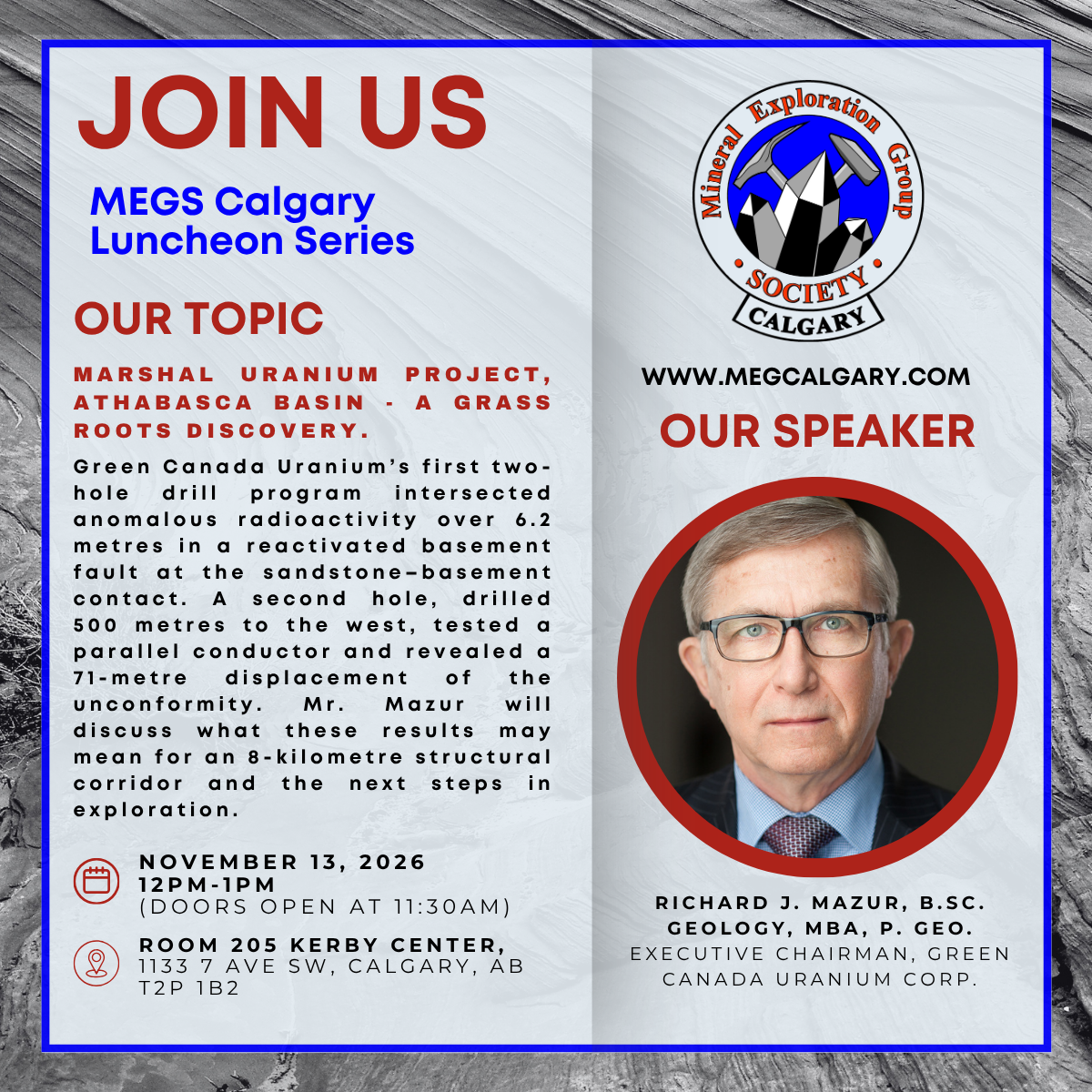
Please join the Calgary Mineral Exploration Group on Friday, November 13 for a talk given by Richard J. Mazur, B.Sc. Geology, MBA, P. Geo.
If you would like to attend the luncheon, please RSVP by email at megcalgary@gmail.com or by selecting one of the options below.
**Please RSVP as soon as possible to accommodate everyone for lunch.
If you’d like to pay the Membership or Luncheon fee online, please click on the appropriate link below to be redirected to the secure Square website. Otherwise cash payment is available at the door.
- Annual Membership (Individual/Students) : $50.00 (plus GST) from 26.50(opens in new tab)
- Corporate Membership : $475.00 (plus GST) from 262.50(opens in new tab)
- Student Program Sponsorship: $500.00 (plus GST)(opens in new tab)
- Luncheon (Members): $40.00 (plus GST) from 31.50(opens in new tab)
- Luncheon/ Field Trip (Non Members): $50.00 (plus GST)(opens in new tab)
- Luncheon (Beverage only): $20.00 (plus GST) from 10.50(opens in new tab)
- Social Events : $20.00 (plus GST)(opens in new tab)
- University, SAIT, NAIT students: FREE with student ID (with purchase of membership)
Luncheon Details:
Date: Friday, November 13, 2026
Location: Kerby Centre – downtown Calgary (1133 – 7th Ave. SW)
Doors open at 11:30 am
Talk starts at 12:00 pm (NOTE TIME FOR THIS LUNCHEON)
NOTE: There is complimentary parking at the Kerby Centre. Parking lots are located beside the building (east) or across the LRT (North). Register your vehicle at Reception.
Abstract:
Green Canada Uranium (TSX.V: GCUC) acquired the Marshall property from Australian based Basin Energy Ltd. as part of its RTO and go public transaction. Trading commenced on September 9 and Green Canada completed a two hole drill program on October 3.
The first hole intersected anomalous radioactivity over 6.2 metres in a reactivated basement fault at the sandstone/basement unconformity contact. Serendipity or Good Science? The second hole 500 metres to the west tested a parallel conductor which revealed that the fault structure hosting the uranium mineralization displaced the unconformity contact by 71 metres. This is further evidence that the uranium mineralized fault has seen periods of reactivation necessary for uranium mineralized fluids to migrate and form large, high grade uranium deposits typical of the Athabasca Basin. Airborne geophysics has identified this structure for over 8 kilometres. Mr. Mazur will discuss the next steps for follow-up of this exceptional start to a grass roots exploration play, albeit along a well located structural corridor for uranium deposits in the eastern Athabasca Basin, Saskatchewan.